

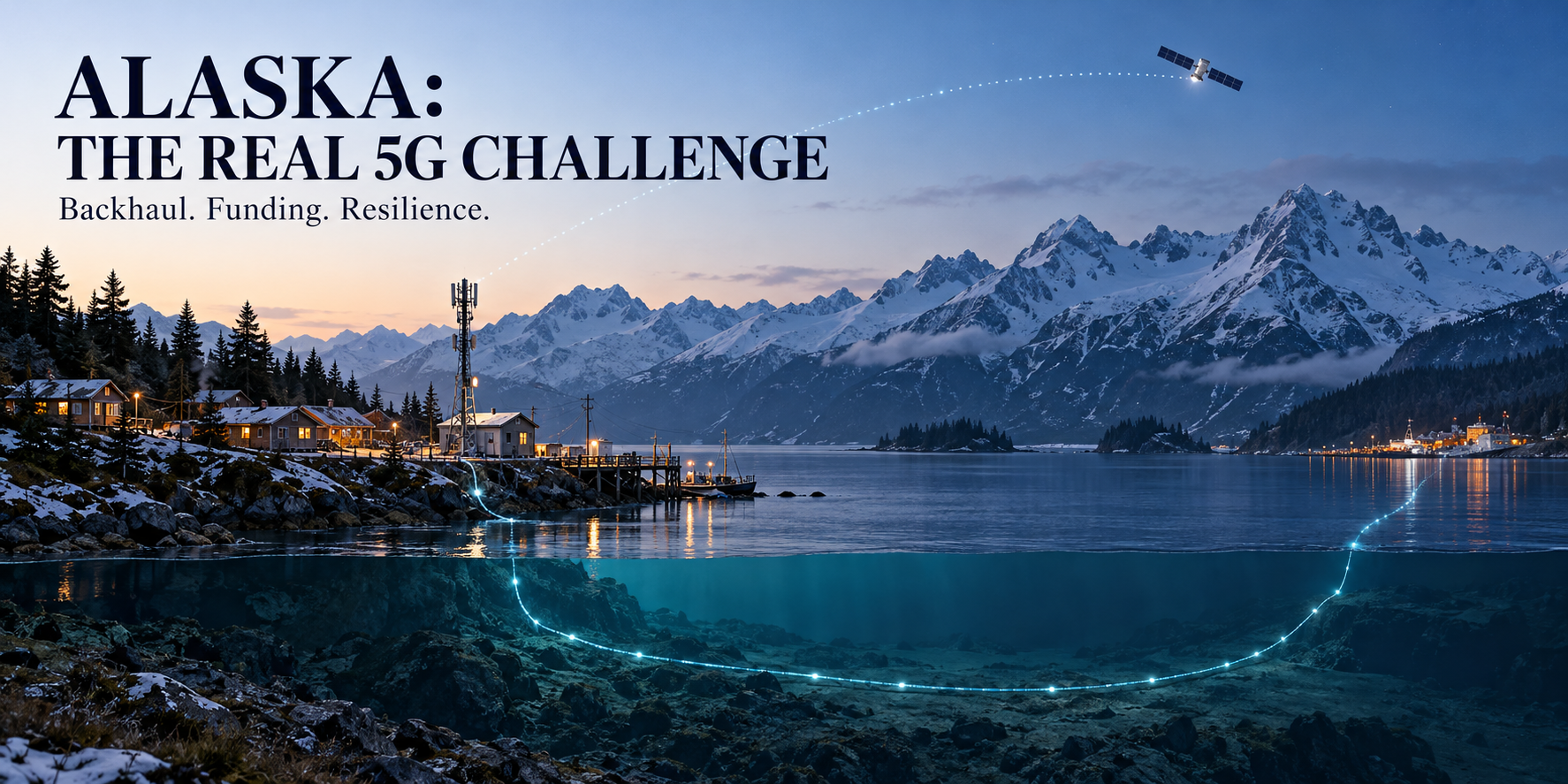
For three decades, I have sat at the table with regulators in capitals such as Bogotá, Basseterre, London, and Seoul, and the conversation about rural connectivity almost always begins in the same place: spectrum. Which frequency, which auction, which coverage obligation. Yet that is usually not the right starting point. The clearest proof comes from an unexpected place: Alaska.
Alaska is an anomaly in the United States’ telecommunications: too big, too cold, and too sparsely populated to be an example of early adoption of new telecommunications technologies. But Alaska is not really an anomaly; it offers lessons valuable both inside and outside the United States. Here one can observe how technologies evolve when the market alone cannot sustain them.
In this state, for example, 5G is first and foremost a question of backhaul and funding, and only afterward a question of radio access. This could be just as true in Finnish Lapland or Canada’s Northern Territories as in Siberia.
Alaska covers about 1.72 million square kilometers and has around 730,000 inhabitants: roughly one person per 2.6 square kilometers, with 40% of the population concentrated in a single metropolitan area, Anchorage. About 80% of Alaska’s communities are not connected to the road network. People reach them by plane or barge during the shipping season, and construction must be completed within a brief summer window. If one misses that window, the project slips by a year.
The market has three tiers:
- National operators serve the cities and the road corridor.
- A statewide integrated operator runs mobile, cable, and fiber networks, as well as a microwave backbone, and sells wholesale capacity to smaller operators.
- Local rural operators: member-owned cooperatives, a private equity group serving some two dozen communities without road access, and island operators relying on satellite backhaul.
As in many parts of the world, most Alaskan villages have only one network operator, and the technology map is treated as an appendix to geography. That is why, as in countries with vast territories and low population density in remote areas, LTE sustains rural networks, with some operators already deploying VoLTE and others still working on it. In addition, parts of the network serving roadless areas still run on 2G and 3G. 5G Non-Standalone (NSA) is present in urban and road-connected areas, but not every operator offers it.
Anyone who has worked on rural connectivity will recognize this picture: a capital, a large national operator, and a periphery of small regional or community networks spread across terrain that makes road-building difficult. I have seen this structure in Peru, in Colombia’s Orinoquía region, and in the island chains of the Eastern Caribbean. Similar conditions appear in the fjords of northern Norway, the mountain villages of the Balkans, the Mongolian steppe, and rural African community networks.
The Need for Backhaul
The similarities do not end there. When Alaskan operators are asked what the biggest constraint on 5G is, the answer is not “radio spectrum,” nor “device availability or variety,” and still less “core network architecture,” but backhaul. Here, as everywhere, a new mobile generation adds little when the link connecting the base station to the rest of the network cannot carry the traffic.
As with everything in life, every backhaul option has its advantages and drawbacks:
- Geostationary satellites reach many villages, but they are expensive and slow.
- Subsea fiber transforms the regions it reaches, although a route with no alternative can leave them isolated for months if the cable is cut.
- Microwave chains that follow rivers and coastlines are reaching their maximum capacity and are exposed to storms.
Low Earth orbit (LEO) satellites are the best hope for cheaper, more reliable backhaul, although coverage at polar latitudes remains limited. Operators also want the satellite spectrum their backhaul links use to be protected when frequencies are reallocated. Regulators worldwide should note, before reallocating frequencies, which rural networks quietly depend on them.
This is not limited to Alaska. Tonga lost its only international cable during the 2022 volcanic eruption and was cut off for weeks. Both Svalbard (Norway) and the Shetland Islands (Scotland) have suffered subsea cable failures in recent years that isolated areas or degraded service, and the Baltic Sea has become a theater of cable damage that European governments now treat as a security issue. Indonesia, for its part, built the Palapa Ring, a state-backed fiber-optic backbone spanning the archipelago, before asking operators to expand coverage.
Nevertheless, across much of Africa, Eastern Europe, and Latin America, public policy debates still start from spectrum auctions and 5G coverage targets. Alaska suggests reversing the order: first fund transport networks with alternative routes, and then assess what the radio access layer can contribute.
Funding Is the Real Blood
For many rural sites in Alaska, the lack of recurring support makes them economically unviable. Thus, funding, not demand, determines whether a network exists.
Alaska’s support regime is currently in transition. In 2016, the Alaska Plan established a 10-year universal service framework for the state. In 2024, the Affordable Connectivity Program ended, and the Federal Communications Commission (FCC) approved the Alaska Connect Fund as the Alaska Plan’s successor. Between 2026 and 2028, the Alaska Plan ends, and operators become subject to the new fund’s obligations. Meanwhile, the Broadband Equity, Access and Deployment Program (BEAD), ReConnect, and tribal broadband grants are funding fiber and backhaul networks. In Washington, D.C., the debate continues over who should contribute to the Universal Service Fund.
The cost structure explains why this support’s design matters so much. Federal rules and reporting obligations apply in full, regardless of the operator’s size. Large operators benefit from economies of scale, since equipment doesn’t get cheaper when bought in small quantities. Arctic logistics drive up every project’s cost, and some operators have around twenty employees who handle compliance, operations, and security all at once. Add thawing permafrost, coastal erosion, sea ice, and storms, and the cost structure bears no resemblance to that of the 48 contiguous United States.
For years I have watched universal service funds in Latin America and the Caribbean accumulate unspent balances or finance one-off projects without planning for operating costs. Many African universal service funds have drawn the same criticism. Eastern European member states have turned to European Union (EU) structural funds to deploy broadband in rural areas, and there too the hard question is who bears the cost of running the network once the subsidy runs out. Alaska shows what the alternative requires: recurring, predictable support, with clear obligations, timelines, and transition rules. A tower built with a grant and abandoned because there’s no funding to keep it running isn’t digital inclusion. It’s a white elephant.
Consumers
Against this backdrop, the future of 5G in the state depends on forces external to the market:
- Spectrum refarming makes it possible to introduce Standalone using available bands rather than introducing new ones.
- The shutdown of host operators’ networks, as national partners retire 3G and require VoLTE for roaming.
- Anchor enterprise customers in oil fields, mines, fishing ports, and military installations, which need capacity and private networks.
- Seasonal roaming associated with tourism, cruise ships, and worker camps.
- Device evolution, as handsets and modules compatible with legacy technologies disappear.
Wholesale services and inbound roaming, along with enterprise services and private networks, already generate real returns. Fixed wireless access and IoT monitoring generate some revenue. Network slicing, ultra-reliable low-latency services, and network APIs generate next to nothing because they require a 5G NSA core and a developer community that doesn’t exist.
Much of the 5G narrative sold to governments assumes consumer demand and an app economy are about to take off. In low-demand markets, economic viability depends on anchor institutions and the flow of people passing through. In northern Sweden and Finland, mines, forestry, and ports stand out. In Chile’s Atacama Desert and Zambia’s Copperbelt, mining dominates. In the Mediterranean and Caribbean islands, tourism dominates. In the Pacific and West Africa, fishing ports and offshore energy installations dominate. Public policy should be built around those pillars, rather than on demand that may never arrive.
From the Tower to the Transport Network
What sets Alaska apart from the rest of the United States is where the main bottleneck lies. For a small rural operator in the 48 contiguous states, the limits are spectrum and capital: once licenses and funding are secured, the road network makes building possible. For a small operator in Alaska, backhaul and logistics are the limits. The question isn’t how to bring a base station into service, but how to get traffic out of the village and a work crew in before the season ends.
The roaming row deserves attention. In the 48 contiguous states, a small operator depends mainly on its national partners. In Alaska, the dependence is mutual. Local operators host national operators’ customers on their networks in villages and work sites, and in some areas most residents subscribe to a national operator and use the local network while roaming. That turns the small operator into infrastructure the national operators need, which gives it unusual bargaining power.
The U.S. territories sit somewhere in between. Puerto Rico, the U.S. Virgin Islands, American Samoa, Guam, and the Northern Mariana Islands share Alaska’s insularity and dependence on subsea cables, and they, too, have received targeted support in the wake of hurricanes. But they are compact territories, mostly accessible by road; they have national and regional operators, with 5G already available in their main urban centers, and their climate risk is acute rather than chronic. A hurricane can destroy a network in a day, then reconstruction begins. Permafrost, erosion, and ice wear down Alaska’s network season after season. The territories face a resilience problem. Alaska faces an accessibility problem.
Alaskan operators add a caveat every consultant should keep in view above their desk: benchmarks from the densely populated markets of Western Europe don’t translate well because density and infrastructure economics differ too much. Instead, they look to northern Canada and the Nordic countries. The right comparison group is defined by geography and density, not by flag or continent.
Alaska’s Relatives Around the World
As soon as we stop classifying markets by country and start doing so by distance, density, and backhaul, Alaska finds relatives on every continent. In the Nordic Arctic, Greenland, and Iceland, the parallels include dispersed populations, subsea and microwave backhaul, short construction seasons, permafrost, and ice. Shared cores and state-backed transport networks are already part of the solution there, and Alaska shows what it costs to go without them. In Eastern Europe and the Balkans, mountain villages are losing population, small regional operators carry the load, and rural areas sit outside commercial deployment. Alaska’s lesson for them is that grants build networks, but recurring support keeps them running. In Ukraine and other conflict-affected states, operators keep running on generators and batteries while attackers strike power supplies and cables. In those conditions, resilience and route diversity are funding priorities, not technical add-ons.
Further south, Sub-Saharan Africa and the Sahel face long distances, weak power grids, and universal service funds under pressure. Alaska’s advice there is to build deployment around mines, health centers, and schools, and to treat LEO satellites first and foremost as backhaul. In the Andes, the Himalayas, and Mongolia, communities live beyond the reach of the road network, face extreme climates, and generate little revenue per user. The lesson is to deploy transport before radio access and to compare themselves with markets of similar density, not with distant capitals. Finally, the Pacific Islands and the Caribbean share Alaska’s dependence on a single cable, its exposure to violent storms (cyclones and hurricanes in their case), and its reliance on tourist roaming. For them, roaming is an essential revenue source, and a single cable cut can take a whole country offline.
Lessons from Alaska
Although Alaska is a wealthy territory within a wealthy country, its small operators face the same structural problems as their counterparts in the Global South, on Europe’s eastern and northern peripheries, and in island states worldwide. There are six transferable lessons.
- Deploy transport before radio access. Fund backhaul networks with alternative routes, including LEO satellites, before setting 5G coverage obligations. A modern radio system connected to a single fragile link is a service outage dressed up in modern technology.
- Fund operations, not just construction. Recurring, predictable support with clear transition rules matters more than one-off grants. Small island states and the Andean and Amazonian regions need the same certainty that Alaskan operators are calling for.
- Build deployment around anchor customers and institutions. Mines, ports, energy installations, health centers, schools, and seasonal roaming sustain economic viability. Enterprise services and private networks are where returns appear first.
- Ease the path to 5G SA through shared resources. If small operators reach 5G SA, they will do so through third-party-hosted or shared cores. Regulators should open the door to shared and wholesale core models, rather than expecting every small operator to build its own.
- Scale rules to the size of the operator. Compliance and reporting obligations and industry fees designed for national operators suffocate a twenty-employee company. Alaskan operators even ask that industry membership dues and service fees be calculated on wireless service revenue, not on the company’s total revenue.
- Protect the satellite layer and ensure a level playing field for LEO operators. LEO satellites are both the best hope for backhaul and a retail competitor that can capture residential customers without taking on universal service obligations. The spectrum satellite backhaul depends on must be protected, and regulators must define how those obligations apply to new satellite operators.
Periphery as the Center
The outlook to 2030 is modest as LTE remains the benchmark technology in rural areas, while 2G and 3G are gradually retired. Backhaul resilience becomes a funding priority. Small operators want a say in what 6G will cost, because if costs are set with large urban operators in mind, they will be left out of the global network.
Most of the world’s next billion connections will not come from densely populated cities with fiber under the streets. They will come from places that, in their economics if not in their climate, closely resemble rural Alaska. If the industry designs 5G and 6G with only the network center in mind, the periphery will keep paying the price.
Alaska’s small operators aren’t lagging out of a lack of ambition. They are lagging because backhaul networks, subsidy rules, and device compatibility set the pace. That is true in an Arctic village, and it is also true in Hammerfest, Maramureș, Turkana, Puno, Leticia, Kingstown, and the outer islands of Fiji. The sooner policymakers accept this, the sooner the technology transition on the periphery will stop being an afterthought.
José Otero has spent 30 years advising regulators and operators in 50+ countries across the Americas, Europe, and Asia on the governance of emerging digital technology. He writes here on the widening gap between what digital technologies can do and the rules, institutions, and infrastructure meant to govern them.
Connect on LinkedIn or reach out at jfo@ictdconsult.com.

