

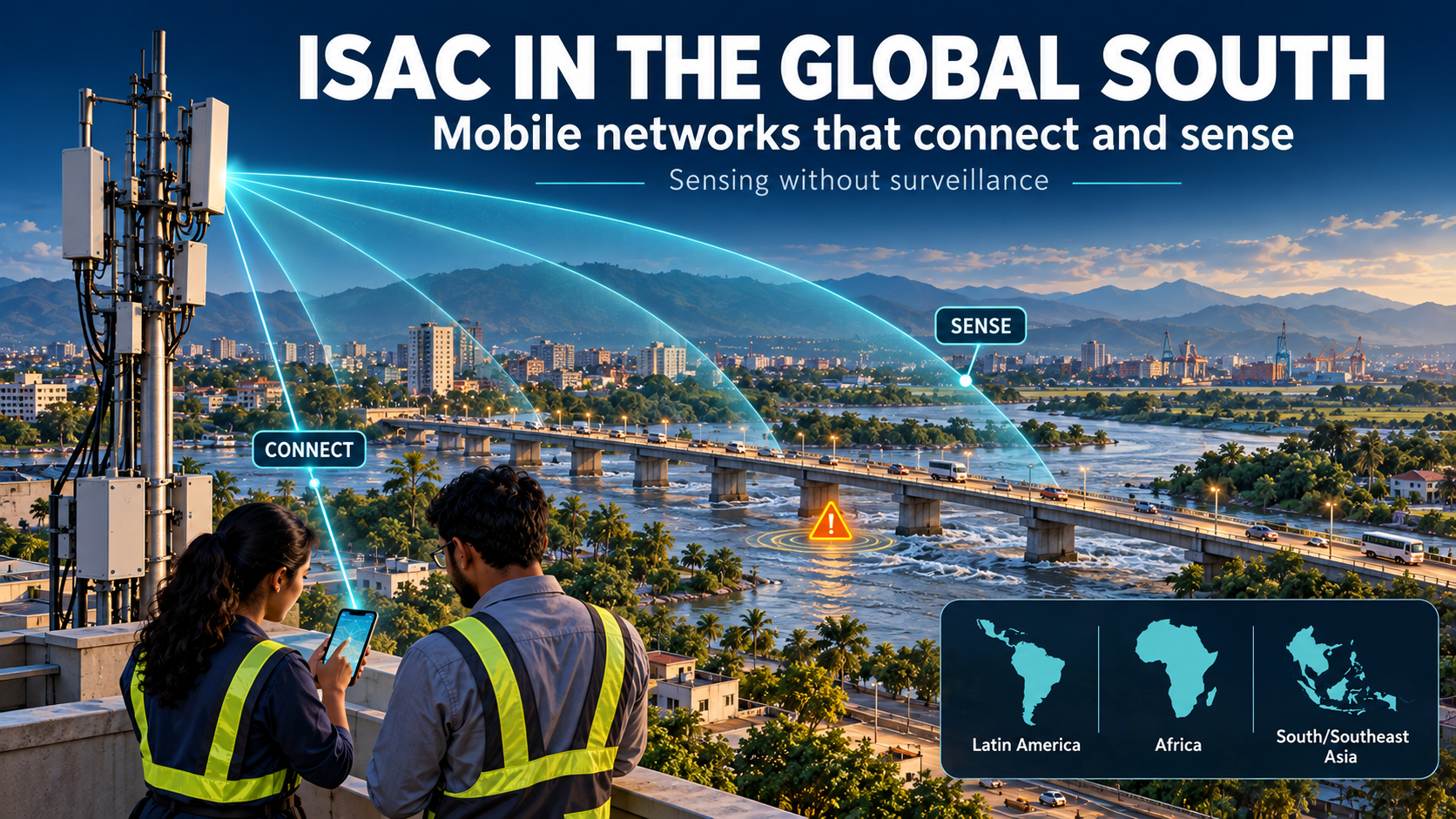
Many countries in the so-called Global South continue to expand their 4G mobile networks while seeing little need to deploy non-standalone 5G networks across much of their territory. Africa, for example, already surpasses Latin America in the number of 5G deployments, yet in both regions several markets remain tied to costly, repeatedly postponed spectrum auctions that delay commercial launches even where demand already exists.
In the Americas, Mexico is perhaps the clearest example: government authorities have been forced to postpone and cancel auctions because RF spectrum for mobile services is so expensive. Across the world, small island developing states (SIDS) also face another challenge: their markets are too small to attract investment at the pace of larger ones.
India, Brazil, and Chile take a different approach. They decided to make exceptions because most of the Global South has been held back by costly or repeatedly postponed spectrum auctions:
- Chile: It was the first Latin American country to auction 5G spectrum in early 2021, and because the auction prioritized coverage commitments over revenue, operators launched commercial service before the end of that year. Some critics said it was a step back from Chile’s history of using beauty contests to assign spectrum.
- Brazil: Its 2021 auction turned most of the spectrum’s value into investment obligations rather than cash for the treasury, including coverage of roads, schools, and an Amazon fiber backbone, which allowed 5G to reach all state capitals quickly starting in 2022.
- India: Although its 2022 auction was expensive, the government eased payment terms for operators, and India went from auction to commercial launch within months and built one of the fastest 5G rollouts in the world.
In this context, a calendar that follows the traditional technology evolution for 6G deployment is a prospect for the next decade, not a decision for this quarter. That time, however, will not be well spent. The obstacles separating ISAC’s promise from its deployment in Global South countries are not primarily technical. They include uneven infrastructure, corruption, security challenges, and a geopolitical environment that pressures countries to choose sides before the standard is even finalized. These non-technical forces will shape how soon we see sensing capabilities deployed in specific locations, such as private networks or government facilities.
First, a key point: ISAC does not require 6G to begin. Existing wireless systems can support experiments and selected applications. Native integration in future 6G networks could reduce additional hardware and integration costs, but economics will depend on the required accuracy, coverage, and reliability.
A Gap That Goes Beyond Spectrum
The first visible constraint is spectrum. ISAC needs wide channels to deliver fine resolution; detecting a small drone requires substantial bandwidth, and high-frequency and millimeter-wave bands are precisely those least available in the Global South. The United States, South Korea, and Japan have allocated several millimeter-wave bands. While much of Latin America, Africa, and South Asia has allocated almost none.
However, RF spectrum is only one part of a wider landscape that includes telecommunications and civil infrastructure. Usually, capital cities with fiber and 5G coexist with rural areas that depend on congested microwave links, diesel-powered towers because reliable electricity is unavailable, and computing capacity concentrated in two or three cities. A sensing network requires dense site coverage, precise synchronization, edge processing, and stable power. Where these basic requirements are missing, ISAC risks reproducing the geography of inequality: fine-grained sensing in connected neighborhoods and blind spots at the margins.
According to GSMA, 96% of the world’s population lives in areas with mobile internet coverage, but 3.1 billion people (38%) do not use it. Another 300 million remain entirely outside coverage. Most of these people live in low- and middle-income countries. The usage gap is ten times larger than the coverage gap. Against that backdrop, presenting network sensing as the next great frontier can seem, at the very least, poorly timed.
Nevertheless, dismissing ISAC as an imported luxury would be a mistake. Properly framed, the technology could address needs particularly acute in the Global South: recurring earthquakes, floods, and hurricanes; informal urban development; critical infrastructure with few monitoring instruments; and emergency services with limited resources. A sensing-as-a-service model focused on early warning, infrastructure protection, or road safety along corridors without dedicated sensors could deliver real value by using existing mobile infrastructure instead of requiring expensive parallel deployments. The key is to build ISAC around local priorities, rather than use cases conceived for other markets. But that would require a comprehensive understanding of local needs in countries where rural and remote jurisdictions have historically been ignored.
Early Adopters and the Gulf Opportunity
The Global South is not a single market with a single timetable. It includes countries struggling to extend basic connectivity and wealthy states that can finance early sensing markets. Beyond the United States, China, and the European Union, plausible early adopters include countries facing substantial security threats and those leading in the adoption of new wireless technologies. Security demand alone, however, is insufficient: funding, capable operators, institutional capacity, and an identifiable paying customer will determine whether interest becomes deployment.
The UAE and Saudi Arabia are particularly plausible early commercial customers and testing grounds, even if suppliers in China, the United States, and Europe provide much of the underlying technology. In the UAE, du has deployed 5G-Advanced capabilities on its live network with Huawei and established a broader partnership for 5G-Advanced development. These steps provide a foundation for trials and enterprise services. They do not establish a nationwide commercial sensing service.
Saudi Arabia combines operator infrastructure, research institutions, funding, and potential public-sector customers. stc and Nokia have a government-supported 6G partnership, while the Communications, Space and Technology Commission has announced a 7 GHz trial with the two companies. KAUST also conducts explicit ISAC research, including designs for high-altitude platform stations. These activities indicate preparation and research capability, but the spectrum trial itself does not demonstrate ISAC deployment.
Elsewhere, the evidence supports more modest conclusions. Qatar-based researchers have published work on ISAC security, indicating research participation rather than leadership in commercial deployment. Indonesia’s government planning includes 5G-Advanced, 6G, drones, high-altitude platforms, and maritime communications, alongside discussions of future mobile spectrum. These are relevant capabilities and needs, but they do not establish an operational ISAC program. South Africa participates in BRICS research cooperation and shared research infrastructure, providing a possible route into collaborative development; that cooperation is broader than ISAC.
Across BRICS and the wider Global South, documented interest in 6G is therefore broader than demonstrated ISAC deployment. Strategic interest, academic research, commercial readiness, and operational services are distinct stages. The evidence considered here is insufficient to identify Egypt, Ethiopia, or Iran as early ISAC leaders. These distinctions matter because a forecast of potential demand can otherwise be mistaken for an established market.
The Gulf’s most plausible initial markets are enterprise and government services. Airports and logistics operators could seek drone detection, low-altitude traffic monitoring, and movement tracking. Ports and industrial facilities could combine sensing within defined operating areas with private-network connectivity. Energy infrastructure operators could purchase perimeter monitoring and detection of approaching objects, while transport and urban authorities could test selected road-safety, traffic, and public-space applications. These are prospective markets, not verified Gulf ISAC contracts. Radio sensing cannot automatically measure pipeline leaks, water chemistry, or equipment condition. Many such tasks still require dedicated instruments.
The strongest early business case is likely to be a bounded site with a paying customer and measurable requirements. An operator could charge for sensing coverage, alerts, or access to processed observations, but would need to show an advantage over dedicated radar, cameras, or other sensors. The UAE could move quickly through operator-led commercial pilots, while Saudi Arabia could develop larger programs around infrastructure and industrial projects. This is a forecast, not a deployment finding. Neither country needs nationwide 6G to begin experimenting, and their purchasing power could shape suppliers’ designs through requirements for detection accuracy, secure data access, interoperability, and limits on reuse. The same infrastructure may support industrial operations, public safety, and surveillance, making governance urgent from the first pilot.
Corruption: Who Controls the Sensor?
Corruption in spectrum allocation and public technology procurement is no hypothetical concern in many Global South countries. The best-known case is India’s 2G spectrum scandal, which led the Supreme Court to cancel 122 licenses in 2012. It is far from the only one: discretionary allocations, behind-the-scenes extensions, and “safe city” contracts awarded without competitive bidding or public disclosure recur across continents. With ISAC, the stakes are no longer just the fiscal value of spectrum. Whoever controls the sensing layer will control information about the movement of people, vehicles, and goods. If that layer is awarded through opaque processes, capture shifts from the economic sphere to the political one. Competitive, transparent auctions; full contract publication; beneficial ownership registries; and regulators with genuine budgetary autonomy are the first line of defense, long before any technical standard.
Security: Between Crime and Surveillance
Security in the Global South has two faces. The first concerns the network itself. Battery and cable theft, tower vandalism, and the extortion of technicians by criminal groups that control territory already increase costs and delay deployments in countries as different as South Africa, Mexico, and Haiti. The 2022 ransomware attack that crippled Costa Rican government systems also showed how fragile digital institutions can be in medium-sized countries. A network that senses also creates a new attack surface: sensing data can be falsified, manipulated, or leaked, and a false alarm involving critical infrastructure can be as costly as a missing sensor.
The second face is more sensitive. ISAC can infer the presence and movement of people who carry no device at all. In countries with uneven data protection frameworks, weak institutional enforcement, and relatively recent histories of state surveillance, the distance between a public safety tool and surveillance infrastructure becomes dangerously short. Purpose limitations, data minimization, access controls, restricted retention, independent auditing, and effective judicial oversight cannot be added afterward: they must be embedded in the design and the rules before deployment. For fragile democracies and SIDS, this governance is the condition that separates progress from a rollback of rights.
International Relations: Choosing Without Becoming Trapped
6G is being developed amid intense technological rivalry between the United States and China. Supplier restrictions, semiconductor export controls, and financing conditions turn every equipment purchase into a diplomatic decision. For many countries in the Global South, the dilemma is uncomfortable: cheaper equipment may carry political costs, while geopolitical alignment may carry financial ones. If the standard fragments into two ecosystems, smaller markets will bear the additional costs, with less scale to negotiate prices and less capacity to maintain two supply chains.
That is why WRC-27, which will examine bands such as 4.5 GHz and 7–8 GHz for the next phase of mobile evolution, including 6G, is not a distant concern. It is the forum where decisions will determine whether affordable, compatible equipment will be available globally or whether we will once again pay the price of fragmentation. Regional bodies like CITEL in the Americas, the ATU in Africa, the APT in Asia-Pacific, and the Arab Spectrum Management Group can enter those negotiations with their own positions, coordinated with one another, rather than passively accepting standards developed elsewhere.
A Seat at the Table
One asymmetry the Global South can begin correcting now is that governments, operators, and manufacturers from the North have dominated the 6 G conversation, with little participation from academia and regulators in our countries. South–South cooperation, coordination among regulators, and collaboration with universities on measurement methods, evaluation, and public policy offer a way to influence the standard while it is still being written, instead of simply inheriting it. The cost of failing to do so is familiar: once again buying technology designed without considering Global South’s needs at a higher price and later.
BRICS could help organize integrated sensing and communication (ISAC) research and demand through joint projects and infrastructure sharing, but Russia, Brazil and China bring different capabilities and constraints. China combines major telecom vendors with active participation in IMT-2030 standardization, positioning it to contribute equipment, research and technical proposals. Its international reach nevertheless faces supplier security scrutiny: the European Commission considers Huawei and ZTE higher-risk 5G suppliers. This assessment concerns supplier trust and governance; it does not establish that Chinese ISAC technology is inherently insecure.
Russia faces a more restrictive geopolitical and supply-chain environment. Sanctions and controls on advanced semiconductors, software and dual-use technology constrain access to components and international partnerships. Its potential participation therefore requires separate assessments of technical feasibility, counterparties and permissible technology transfers. BRICS membership does not remove these restrictions or establish interoperability with Chinese or Brazilian systems.
Brazil offers a distinct role in research, regulation and application development. ANATEL’s work on 6G, open networks and AI supports participation in global technical forums. For Brazilian deployments, sensing applications that process personal data would also need to address the LGPD’s privacy requirements. Brazil’s role should therefore be assessed through its own research institutions, regulatory priorities and commercial needs, rather than inferred from China’s supplier capabilities or Russia’s geopolitical position.
These differences mean BRICS should not yet be treated as a unified ISAC ecosystem. The cooperation reviewed here does not establish a common BRICS ISAC standard, procurement program, or deployment roadmap. Satellite remote-sensing cooperation is a separate activity and should not be presented as evidence of cellular ISAC deployment. Gulf buyers, meanwhile, can influence products through procurement requirements, including interoperability, cybersecurity, data governance, and sensing performance even when they do not supply the underlying technology.
The decisive question, then, is not whether 6G networks will be able to sense, but whether the Global South will shape that capability around its own priorities: closing the usage gap, safeguarding public procurement against corruption, protecting rights, strengthening disaster response, and preserving its international room for maneuver or import infrastructure designed to serve the strategic aims of others. The real test will not be technical. It will be enabling the network to sense more without our societies, so often subjected to surveillance, losing control over what that sensing reveals. Sensing without surveillance: that should be the Global South’s standard.
José Otero has spent 30 years advising regulators and operators in 50+ countries across the Americas, Europe, and Asia on the governance of emerging digital technology. He writes here on the widening gap between what digital technologies can do and the rules, institutions, and infrastructure meant to govern them.
Connect on LinkedIn or reach out at jfo@ictdconsult.com

