

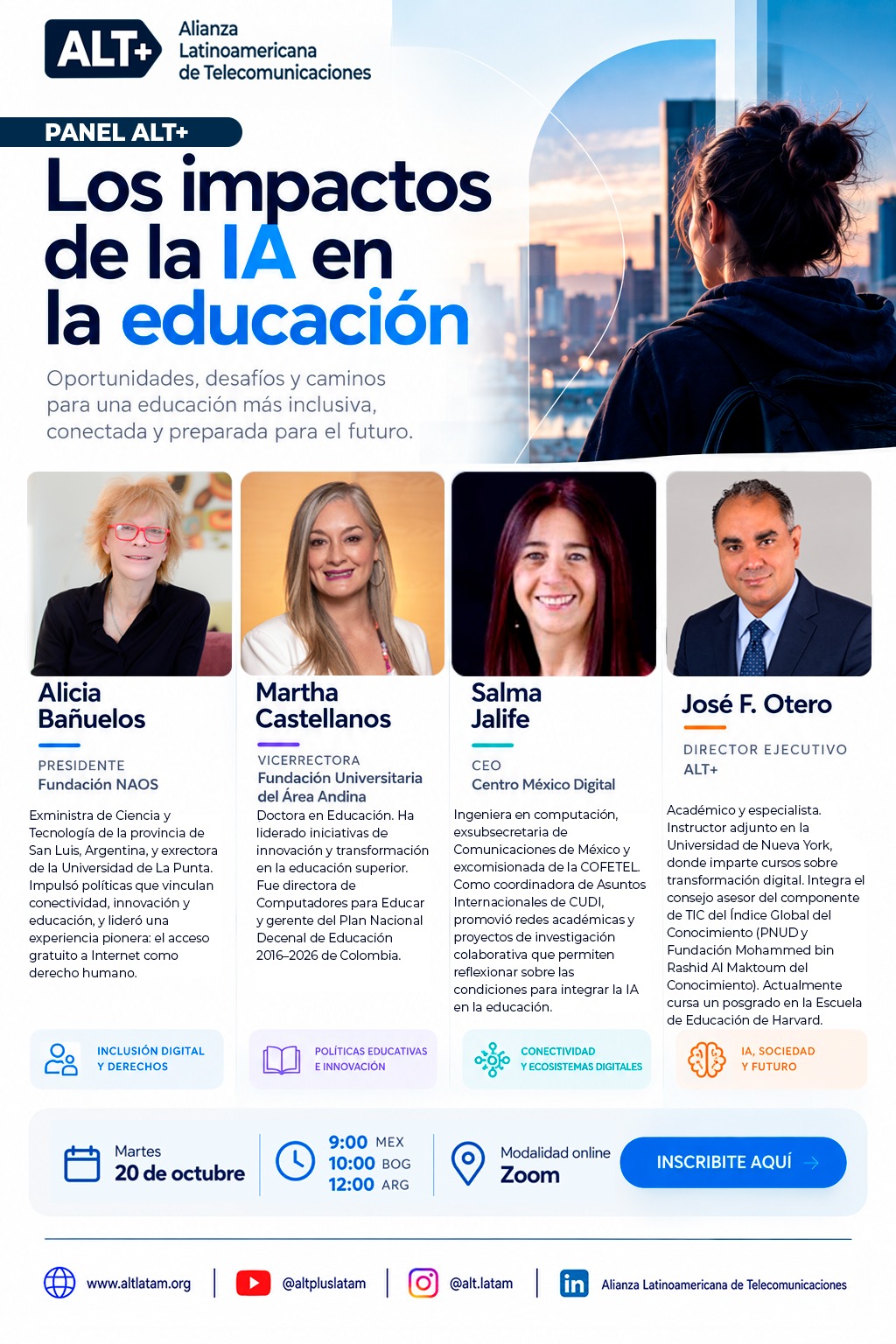
Artificial intelligence will magnify existing conditions in Latin American schools rather than fix them, and teachers, not technology, will determine the outcome. “The Impacts of AI in Education,” a webinar organized by the Latin American Telecommunications Alliance (ALT+) with the Regional Technical Commission on Telecommunications (COMTELCA) and moderated by José F. Otero, ALT+’s Executive Director, reached the same conclusion. Otero asked the panel to move past abstract debates on ethics and focus on what AI can actually do, so it drives educational development instead of widening the digital divide.
The three panelists placed the main obstacle at different levels of the education system. Salma Jalife argued that structural access comes first. Without meaningful connectivity, affordable devices, and real digital skills, AI creates only an “illusion of modernity” and leaves rural and low-income students further behind. Dr. Martha Castellanos warned that students who arrive at university with weak foundations risk “cognitive replacement,” handing their thinking over to AI. She called on universities to train “digital humanists” who treat AI as an adversary that offers hypotheses rather than conclusions. Dr. Alicia Bañuelos showed that the decline in deep thinking began decades before smartphones or ChatGPT, and that the root problem is reading comprehension, which only teachers can rebuild. Despite their different diagnoses, all three agreed on the same priorities: invest in teachers, assess how students think, not just what they produce, and keep people, not machines, in the learning loop.
The following is a summary of each presentation.
AI as an amplifier of inequality
Salma Jalife argued that the obstacles to equitable AI in education are structural and economic, not pedagogical. She began by rejecting what she called the “technocentric temptation”: treating technology as an end in itself. Instead, she proposed a systemic approach. Education does not happen in a vacuum. It sits inside an ecosystem of infrastructure, household economics, public policy, and human capacities. That ecosystem decides whether an innovation becomes a bridge to inclusion or a gap that deepens inequality.
Her central premise is that technology does not create new realities; it magnifies existing ones. Where connectivity, affordability, and urban–rural gaps are sharp, a rapid rollout of generative AI and adaptive learning creates an “illusion of modernity” while leaving large parts of the population behind. She said proposing AI as a pedagogical solution in a system that lacks basic infrastructure is like building advanced buildings on foundations of sand.
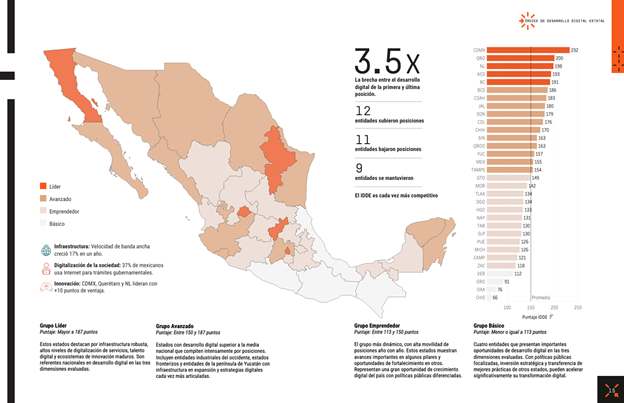
Her evidence comes from Mexico’s State Digital Development Index (IDE), now published for five years across all 32 states. It measures three pillars: infrastructure; digital skills and capacities; and innovation and technology adoption by firms. Year after year, the index shows uneven digital development. Regions with high technological capacity sit alongside states and municipalities with severe structural lags.
Salma did not dismiss AI’s promise. Once the access barrier is overcome, she said, the benefits can be profound. Intelligent tutoring can adapt to each student’s pace, style, and level, offering individual learning paths that reduce school failure and dropout. AI can lighten teachers’ workload by automating administrative tasks, rubric design, and draft lesson plans, returning the teacher to the role of mentor, emotional guide, and facilitator of critical thinking. It can also act as a multilingual, accessible assistant that brings specialized knowledge closer to local and community contexts.
The problem is reaching those benefits. Read through the index’s pillars, and three “Gordian knots” stand out. The first is the infrastructure gap between city and countryside. High-speed broadband remains concentrated in large urban centers, so an urban student can use real-time simulators and conversational tutors, while a rural student has no connection, or only a slow, intermittent one. The second, which she called the Achilles’ heel, is affordability. Laptops, tablets, smartphones, and data plans take a disproportionate share of income in the lowest quintiles; without subsidies or low-cost devices, AI becomes a privilege for those who can pay. The third is digital skills and critical literacy. A connected device is not enough. Without advanced digital skills, information literacy and critical thinking, adoption becomes passive: students consume AI answers without checking sources or detecting bias, which erodes genuine cognitive development.
From this diagnosis, she drew four priorities for national and subnational policy. Every public school, starting in marginalized and rural areas, needs meaningful connectivity: robust networks, reliable electricity, and secure local networks. Governments should promote low-consumption hybrid models, such as edge computing and AI that runs locally or with little bandwidth, to reduce dependence on the cloud. Teacher training must be ethical as well as practical, covering algorithmic bias, data privacy, and pedagogical integration, not only how to operate tools. Finally, targeted affordability strategies, including financing schemes, equipment reuse, and public–private partnerships, should put devices in the hands of students in the lowest-income quintile.
She closed with a warning. AI is not a magic wand that will fix the region’s school systems’ historic deficiencies. If connectivity, affordability, and skills aren’t addressed first, AI will act as a magnifying glass, amplifying existing gaps. The real challenge isn’t how much technology reaches classrooms, but whether digital transformation closes the opportunity gap so AI’s promise becomes “a universal right and not a geographic or economic privilege.”
Answer to the moderator
Otero asked how a public policy for teacher training should be structured so that AI is integrated pedagogically, ethically, and critically, rather than as a simple substitute for traditional practice.
Salma first endorsed the other panelists’ emphasis on human-centered learning and on reading and writing. She said an effective policy should focus not on how to use the software, but on pedagogical and critical-thinking competencies. She proposed three axes.
The first is a competency framework based on international standards. It would cover AI pedagogy, use adaptive systems connected to students’ daily lives as Mexico’s community-centered model proposes, and support differentiation in mixed-ability classrooms. It would teach ethics and algorithms: where biases lie, what errors models make (“hallucinations”), and what privacy risks exist. It would stress shared responsibility among the teacher, the student, the developer, the implementer, and the user. It would reconfigure assessment toward authentic tasks, projects, critical audits of AI-generated answers, and local problem-solving, replacing memorization and automated homework.
The second axis is the format of continuing education. One-way mass courses, whether technical or theoretical, should give way to teacher communities of practice: hands-on workshops on lesson planning, reducing administrative load, and co-creating regionalized materials.
The third axis is incentives and institutionalization. Training pathways should link to professional development programs, salary recognition, and institutional credit, so the time teachers invest in technology training counts in their careers.
Training students for a world that has changed
Dr. Castellanos answered her own guiding question, “Are we training students for a world that has changed?”, with a qualified no. She argued that AI failures are educational failures. She made the case through two stories.
Martín is a civil engineer who must build a bridge that more than 40,000 people will cross. Throughout his training, he produced impressive calculations and optimized timelines, all with AI. He never did a calculation by hand, and he never asked whether the results were correct. The AI didn’t know the site’s specifics; Martín trusted it completely, and no one can say whether the bridge will hold.
María is a judge with 48 hours to decide a child custody case and a heavy backlog. She turns to AI for help. She does not notice that the best custodian is a Latin American mother who lacks basic resources but adores her son, cares for him with what she has, and works extra hours to be present. The algorithm rules against her because such patterns don’t exist in the data from developed countries. María was never taught that an algorithm can be unjust because it does not know the particularities of our societies.
These, Dr. Castellanos said, are not stories about what AI did wrong, but about what education is doing wrong, and about what universities may be failing to do.
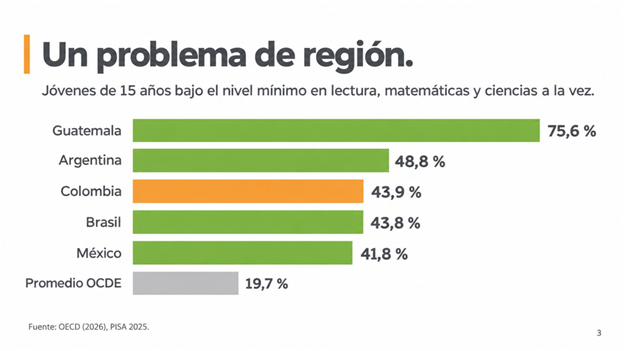
She then turned to the students now entering higher education. In Colombia, 43% of students performed well below the OECD average, not in one basic competency but in all three: reading, mathematics and science. Students who cannot read well arrive at university already at a disadvantage, and she stressed that this is a Latin American problem, not only a Colombian one. PISA also shows that 57% of Colombian 15-year-olds use AI, supposedly to learn. Colombia is among the heaviest users and among those offering the least guidance. “This is not a technology problem,” she said. “It is a system problem.”
That combination produces exclusion. Building on Salma’s point, she argued that the problem is no longer only infrastructure: a student may have the infrastructure and still lack the competencies to benefit from it. She cited a Stanford study on “cognitive replacement”. Just as people stopped memorizing phone numbers once they had mobile phones, students are delegating not a task but their thinking. The share showing this pattern rose from 15% to 19% in a single year. For a weak reader, an AI summary of a book does not build the missing skill; it disguises a competency never acquired in basic education, and now not acquired in higher education either. These graduates then enter a labor market that doesn’t hire them.
In response, the Andean Area University Foundation (Areandina) has set out to form “digital humanists”. These are people who use critical thinking as the helm that steers their learning while using AI to learn better. The human stays at the center, and AI serves only to strengthen what is human. Students must disclose when they use AI, systems should aim to close the gaps students bring, and AI should be an ally that helps solve problems in the students’ environment, not a replacement.
She described several initiatives. Areandina created an Observatory of Digital Humanism and has strengthened the competencies of researchers and teachers, whom she called the most important mentors because they design students’ learning. The previous Friday, 16 October 2026, at a Digital Humanism Forum held with the Embassy of Austria, the university launched its Digital Humanism Framework. Its core purpose is human agency: how students use knowledge to transform their environment and make it relevant.
The most important change, she said, has been in assessment. Teachers have been asked to reconsider whether the essay can remain the answer. Writing essays remains a relevant competency, but students must be pushed to refute, create differently, and solve problems, with AI as an amplifier rather than the product itself. For eight years, the university has also applied its “Sello Transformador” (Transformative Seal): ten core 21st-century competencies that every student develops, whether they are training as engineers, physicians, teachers, or designers, so they can navigate turbulent waters amid rapid technological change. At the base of it all is reading. Students may know chemistry, physics, or mathematics, but if they cannot read the context, they will not solve any problem.
Dr. Castellanos summarized the framework in a few principles. AI cannot be an assistant; it has to be an adversary. AI delivers hypotheses, not conclusions, and humans must build the conclusions and decide what applies to local cases, as María and Martín failed to do. Assessment must evaluate the thinking process, not just the product. Universities should measure agency, meaning what students do with AI, not only access. Teachers must be trained with judgment and relevance, and Areandina is redesigning its entire assessment system. Her closing answer to the guiding question was that there is still a road ahead, but universities must already be training students to take the helm. The task is to strengthen what is human.
Answer to the moderator
Otero asked how universities can train students to create with AI rather than be replaced by it, without leaving behind those who arrive with the largest learning gaps.
Dr. Castellanos said the first step is leveling the playing field. Students arrive with many gaps, as PISA shows, and universities must be responsible: hold an open dialogue about where their students stand and what they need. Leveling is not linear. It is not “now you are trained, start medicine”; it must happen step by step.
The second step is teacher training so students can meet different kinds of assessment. Teachers must approach AI as an opportunity to create valuable learning experiences. Today, she said, many institutions see a troubling loop: the teacher creates the assignment with AI, the student completes it with AI, and the teacher grades it with AI. “Someone here is redundant, and it is not the AI. We are making the human redundant.”
The third step is to have students debate AI. What it produces is not absolute truth. In line with Dr. Bañuelos, she called for a return to reading, because reading gives students the richness to argue back. AI should almost be the movie’s villain, so students can counter-argue, find its biases, and recognize where they themselves need to read and learn more.
The fourth step, central at Areandina, is solving problems in context. With tools such as vibe coding and AI agents, students can address real problems, such as finance for farming communities in rural areas of the Andean region. AI will not solve that problem. But a student who understands the community’s needs can ask AI for guidance, possible solutions, and tools. This makes the student a creator and active user rather than a consumer, and avoids cognitive replacement.
She closed by returning to digital humanism. If AI is allowed to replace people, Latin America will have more gaps than it already has, and cognitive replacement is now a global phenomenon. She acknowledged that the region is not leading the Fourth Industrial Revolution, but it can lead in using these tools to reduce its gaps. That, she said, should be one of higher education’s most important tasks, and education’s in general.
The screen on trial
Dr. Bañuelos argued that screens are not to blame for Latin America’s learning crisis. The real problem is language and reading comprehension, and only teachers can fix it. She framed her talk as a trial. She said society and many specialists have already named the culprit, the screen, as if removing screens would solve the problem.
She began with evidence of the “crime.” Across the 13 Latin American countries in PISA 2025 results, 59% of students scored below Level 2. They cannot identify the main idea of a moderately long text or make basic inferences. The OECD figure is 31%, which is also not good. Dividing the 20-point gap by the OECD’s one-school-year rule of thumb, the region’s students are 3.6 years behind in reading. A 15-year-old reads like an 11-year-old. The gap is 4.7 school years in mathematics and 4.2 in science.
She also stressed the correlation between reading and the other subjects. The correlation between reading and mathematics is 0.8, which is very high, and between reading and science is 0.87. Whoever reads well understands mathematics and can at least follow science, because both depend on vocabulary and deep reading.
The heart of her argument was a timeline that clears the screen. Throughout the 20th century, measured intelligence rose steadily until about 1975: the Flynn effect. From then on, it began to fall: the reverse Flynn effect. In 1977, researcher Anne Newman found that students’ main difficulty in solving mathematics problems was not understanding the problem statement. Mass internet use came only around 1995. Argentina’s PISA reading scores fell between 2000 and 2006, before smartphones existed. PISA declines were first recorded around 2012, and United States reading scores began to fall in 2013. The pandemic hit in 2020, and ChatGPT arrived in 2022. None of these can be the trigger. “Technology amplified what it found,” she concluded, “and it found a society that had lost deep thinking.”
This explains why phone bans disappoint. Banning phones is cheap: one person at the door confiscates devices. Rebuilding play, street life, and the reading of long texts is slow, political, and “has no off switch”. Dr. Bañuelos cited a 2025 study in The Lancet Regional Health – Europe covering 30 English schools: banning phones changed neither anxiety nor depression and did not improve grades. Elsewhere, bans have produced at most a small gain in performance.
She then located the difficulty precisely. Following Newman, solving a problem means reading it, understanding it, transforming it into a strategy, calculating and checking the result. 61% of the effort, and most errors, fall in the first, language-based stages. In short, the difficulty is understanding the instructions.
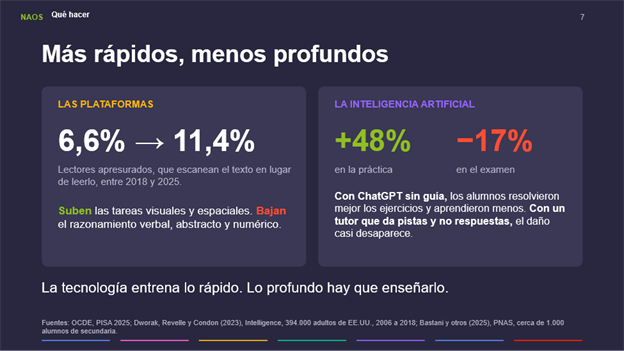
The reverse Flynn effect is also uneven. Visual and spatial abilities are rising while verbal, abstract, and numerical reasoning are falling. PISA shows it: “hasty readers”, who scan rather than read, grew from 6.6% to 11.4% between 2018 and 2025. AI studies point to the same conclusion. Students solving exercises with ChatGPT improve by 48%, but when the AI is removed, their exam results fall by 17%. She said technology does not teach deep thinking. Drawing on Daniel Kahneman’s two systems, she argued that technologies train System 1, the fast, intuitive mode that lets us drive while listening to music. We must teach System 2, the slow mode that needs pen and paper. Teachers teach it, and they are society’s only hope of producing large numbers of people who think deeply again.
PISA’s data on AI use reinforce the point. Nearly half of 15-year-olds use AI to learn, and Latin America is slightly above average. Singapore and the Dominican Republic have almost the same level of AI use but very different results, and Japan uses less AI and scores very well. “If AI does the homework, it subtracts. If the school teaches how to evaluate it, it adds.” What matters is not how much AI is used, but what for and how.
Language, she insisted, is the root. A lack of vocabulary makes people more prone to violence, because they cannot express what they feel, and it blocks comprehension of literature, mathematics, physics, and everything else. Some education systems have taken the bull by the horns. New South Wales made Newman’s 1977 approach state policy, measuring how many children cannot understand problem instructions. Singapore, now unbeatable in mathematics, has applied George Pólya’s four steps since 1990: understand the problem, plan, execute, and review. Since 2026, China has had a national reading regulation requiring public facilities to support reading. “Technology is a tool,” she said. “Language is what makes it work.”
The school, and then the university, is therefore the last place left to read slowly and train System 2. The wider environment, from TikTok to social media, constantly trains System 1. Families cannot reach every child, because support depends on parents’ socioeconomic level, but teachers can. Only a teacher can make students reread, and Newman’s questions and Pólya’s steps are protocols for slow thinking that work only in the classroom. Teachers are indispensable in the technological era, because deep thinking can be taught and its natural home is the classroom.
Dr. Bañuelos ended with concrete proposals. By the end of first grade, every child in Latin America should read 40 words per minute and handle the four operations up to 10. Students already past first grade need a mitigation plan: diagnose where each one stands and recover reading before continuing the curriculum. Otherwise, teachers deceive themselves, believing that everyone is fine because the lesson was taught, when the real difficulty was far more basic. And every teacher, whether of mathematics, physics, or social studies, must teach reading: “Read before asking, read before calculating.”
Her verdict acquitted the screens but not the region’s educators. Many knew the results and knew the problem was reading, yet no Latin American country has a systematic plan to attack reading comprehension, meaning the ability to make inferences, from first grade through university. “Technology is the engine,” she said, “but language is the steering wheel.” Platforms will not change, and states find change difficult, so teachers, the people actually in front of our children, deserve all our support.
Answer to the moderator
Otero noted that platforms reward speed and that hasty readers nearly doubled between 2018 and 2025. He asked who is responsible for developing deep readers: platforms, regulators, schools, or families.
Bañuelos answered that the platforms were designed to make money and will keep doing the same, whatever modest mea culpa they offer. Regulators also face limits, since a phone ban won’t happen while everyone else keeps using them. Changes can happen in each classroom, because each classroom has a teacher, and that teacher must understand the problem.
The problem is not only how AI is used. Teachers can be taught to use AI as a Socratic mentor, have it evaluate students’ questions rather than hand out answers, and use many other strategies. But every teacher must understand that the root problem is reading. Students, even university students, do not understand the instructions. She welcomed every AI course, Salma’s plans, and Dr. Castellanos’s ideas, but insisted teachers be convinced of this with a clear north star, because the classroom is the only hope.
She returned to Dr. Castellanos’s example of AI writing the assignment, AI answering it, and AI grading it. What must be verified is whether the student understood what was asked. Her recommendation was that every AI course for teachers, besides explaining the advantages of the different models, should “talk about reading and talk about Newman”, extending his approach to every discipline.
Conclusion
All three panelists agreed that AI amplifies existing conditions rather than correcting them, and that the teacher is the decisive actor. Each placed the binding constraint at a different level.
For Salma, the constraint is structural access. Connectivity, affordability, and digital skills determine whether AI widens or narrows inequality, and policy has to fix those foundations first. For Dr. Castellanos, it is human agency in higher education. Universities must level students, redesign assessment around the thinking process, and teach students to treat AI as an adversary that offers hypotheses rather than conclusions. For Dr. Bañuelos, it comes down to foundational reading comprehension. Learning decline predates screens and AI, and only systematic, classroom-based teaching of slow, deep reading from first grade onward can reverse it.
Their answers to the moderator converged on the same image: a loop in which AI writes the assignment, AI completes it, and AI grades it. The panel concluded that education must keep the human in that loop by verifying understanding, investing in teachers, and rebuilding the capacity to read.
Biographies
Alicia Bañuelos. Former Minister of Science and Technology of San Luis and former Rector of the University of La Punta, she has championed policies linking connectivity, innovation, and education. During her tenure as rector, the university promoted digital inclusion and contributed to the provincial initiative that made San Luis the world’s first jurisdiction to recognize free Internet access as a human right—an experience relevant to discussions about who will benefit from AI in education.
Martha Castellanos. With a doctorate in Education, she serves as National Academic Vice Rector of Fundación Universitaria del Área Andina and has led initiatives promoting innovation and transformation in higher education. Her public-sector experience includes heading Computadores para Educar (Computers for Education) and managing Colombia’s National Ten-Year Education Plan 2016–2026. These roles inform her perspective on integrating AI into education policy and practice.
Salma Jalife. A computer engineer, former Undersecretary of Communications of Mexico, and former Commissioner of the Federal Telecommunications Commission (COFETEL), she has extensive experience in connectivity policy. As Coordinator of International Affairs at the University Corporation for Internet Development (CUDI), she promoted academic networks and collaborative research projects that offer insights into the conditions needed to integrate AI into education.
José Felipe Otero Muñoz. An academic and specialist, he is an adjunct instructor at New York University, where he teaches courses on digital transformation and its impact on business, public policy, and culture. He serves on the advisory board that reviews the methodology for the information and communication technology component of the Global Knowledge Index, published by the United Nations Development Program (UNDP) and the Mohammed bin Rashid Al Maktoum Knowledge Foundation.
José Otero has spent 30 years advising regulators and operators in 50+ countries across the Americas, Europe, and Asia on the governance of emerging digital technology. He writes here on the widening gap between what digital technologies can do and the rules, institutions, and infrastructure meant to govern them.
Connect on LinkedIn or reach out at jfo@ictdconsult.com.

