

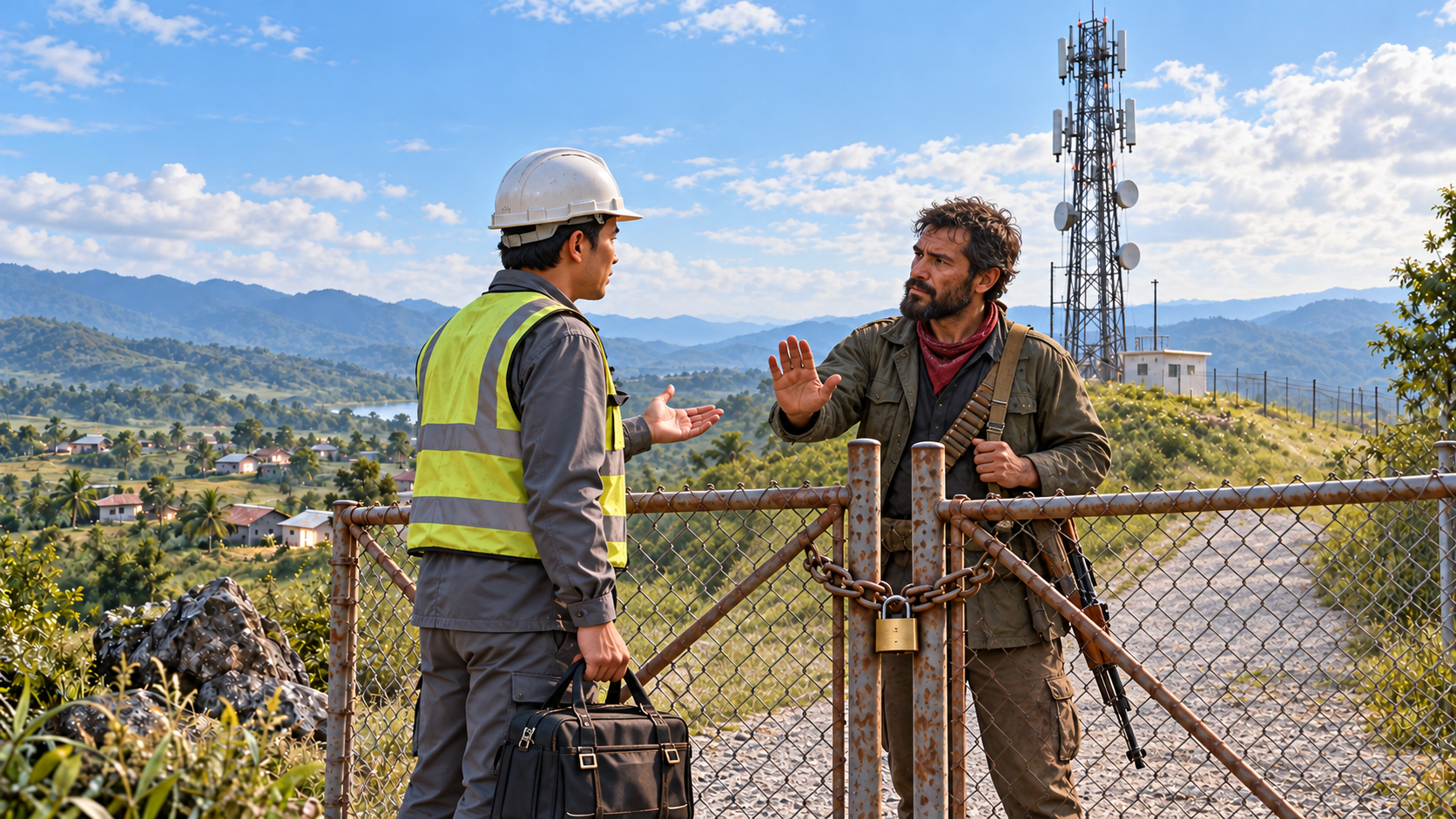
Many people in the telecommunications industry first encountered the term “narco- and parasite- antennas” early this decade, when Reuters reported the story of a Mexican technician who, during routine work, cut the power to a cell tower and found himself face to face with armed cartel members. As you might expect, the tower carried not only mobile operators’ traffic but also a criminal network’s communications. Unsurprisingly, its users did not take kindly to the service interruption.
What this episode reveals is one of the great taboos of the digital and telecommunications ecosystem worldwide: the dangers of extortion, threats, kidnapping, sabotage, and national security that are ignored when international forums discuss the importance of connectivity. It is easy to talk about spectrum auction policy, coverage obligations, universal service funds, and infrastructure sharing when deployments are assumed to take place on neutral, conflict-free ground. This blind spot matters all the more because 119 of the 169 targets of the 17 Sustainable Development Goals are said to depend largely on digital technologies for their success.
Unfortunately, reality is different. In large parts of Latin America, Africa, and Asia, the state is absent, and someone else owns the territory. The hardest places to connect are not the remote ones. They are the contested ones, where armed groups, criminal networks, and corrupt officials decide who can enter, build, repair, and sell. In those places, the right question for an operator is not “Can we build here?” but “Can we keep operating and repairing here without exposing ourselves to unacceptable danger or coercion, or causing harm to users?”
Discussing how to close the digital divide without including security is a waste of time. No matter how good the intentions are or how capable the people who drew up a plan to bring connectivity to everyone, if the state does not control those areas and cannot guarantee the safety of those essential to deploying infrastructure, very little can be achieved.
The classic image of criminal risk to telecommunications networks is theft: copper stripped from cables, batteries and diesel taken from base stations. This problem persists and will continue until people’s perception of the importance of telecommunications networks changes. Even with a new perception of these networks, external factors will always put them at risk. Perhaps, now that many criminal organizations understand that communications let them increase efficiency and cut costs, these same groups will take it upon themselves to protect telecommunications networks. Yes, organized crime, cartels, and terrorists can also benefit from the digital transformation of their operations.
So much so that, in 2024, the Los Viagras cartel in Michoacán installed its own internet antennas and forced residents to pay extortionary prices for its Wi-Fi service under threat of death. In other words, traditional operators now face unfair competition: the cartel charges a monthly fee and almost certainly collects information on the communications that travel over its network. Data collection isn’t exclusive to social media platforms or device manufacturers.
The life of a telecommunications tower
Building a tower is a one-time event that can be planned, escorted, and negotiated. Maintaining it is a recurring exposure. Over its useful life, a single site will require dozens of visits: a failed rectifier, a stolen battery bank, a generator that needs fuel, a fiber cut on the access road. Each visit sends a crew, often subcontracted and poorly protected, into territory where it may not be welcome.
Colombia shows how quickly that territory is changing. According to the Inter-American Dialogue’s August 2026 report Rethinking Security in Colombia, armed groups added some 5,000 members in 2025 and surpassed 27,000, a 24 percent increase in a single year. Clashes between groups rose 34 percent, and the country now has at least 13 active conflict zones, nearly double the number at the start of President Gustavo Petro’s administration. In Antioquia, the governor reports a 70 percent increase in the presence of FARC dissidents, organized under a “franchise model” in which factions operate with some independence under a shared banner.
For an operator, fragmentation is worse than concentration. A single dominant armed actor, however illegitimate, is at least predictable. A franchise of factions, each subcontracting extortion to neighborhood gangs, as the mayor of Puerto Tejada in Cauca describes, means that access agreed on Monday with one group guarantees nothing on Thursday with another. She speaks of “invisible borders” that fragment her municipality, where even short trips can be deadly. A technician based on one side of such a line may simply have no way to reach a fault on the other side.
What Colombia is experiencing, however, is neither new nor unique. Nigeria learned the cost of this situation a decade ago. In 2016, BusinessDay reported that the Boko Haram insurgency had destroyed 193 base stations belonging to MTN, Glo, Airtel and Etisalat in Adamawa, Borno and Yobe states. Rebuilding them was estimated to cost about ₦4.8 billion (roughly US$24 million at the official exchange rate of the time), or ₦24.75 million (about US$124,000) per site for the mast, antennas and two generators. But one caveat was especially revealing: rebuilding only made sense once the army had pushed the insurgents back.
Also in Africa, Somalia shows that destruction can be a deliberate strategy. In November 2022, al-Shabaab detonated a truck bomb at Hormuud’s facilities in Qaayib, in the Galguduud region, destroying the local telecommunications center and its tower. Hormuud said the group was deliberately targeting its infrastructure to limit communication and coordination against it. About 14,000 people lost service, including EVC Plus, the area’s only mobile money platform. This illustrates some of the externalities of losing connectivity: every service that depends on it, from money transfers and education to telemedicine and entertainment, becomes inaccessible.
Why should we care about the security of telecommunications networks? It is very simple. In the feasibility analysis of a telecommunications project, every cent spent on guards, armored transport, insurance premiums, or informal “protection” is a cent not spent on coverage or capacity: the economists’ famous opportunity cost. Worse still, these costs are highest precisely where the business case was already thin. Historically, these are the low-income, underserved markets that universal service funds and coverage obligations seek to reach.
But violence and insecurity do not travel alone. They come with corruption, even if it operates more discreetly throughout a project’s life cycle. The Organization for Economic Co-operation and Development’s work on infrastructure integrity points to fraud, collusion, undue influence, and conflicts of interest in project selection, procurement, concessions, and contract management, not just bribery. For operators, the exposure points are well known: licenses and municipal permits, rights-of-way and land agreements, customs clearance for equipment, and local contractor ownership. The warning signs are also well known: opaque beneficial ownership, unexplained intermediary fees, cash-only payment demands, pressure to hire a politically connected vendor, and requests to accept “mandatory” local subcontractors or exclusive service territories. In contested regions, the line between a corrupt intermediary and a front for an armed group can be very thin.
This overview leaves some conclusions that may seem obvious. The state cannot promise security to all its citizens until it is sure that no group or individual operating outside the law controls any segment of telecommunications. To prevent that, it must foster a dialogue from the regions to the capital, the well-known bottom-up approach, so that decision-makers can truly understand the needs and dangers faced by the populations most exposed to extortion and to the crimes of illegal groups.
Otherwise, any national venture to bring broadband, connectivity or artificial intelligence to the entire population will remain a mirage. A government cannot promise connectivity in places where it cannot guarantee the safety of the workers who deploy, expand, and maintain telecommunications networks.
That is why, as long as national broadband plans, universal service funds and coverage obligations continue to be designed as if the state controlled all of its territory, the maps will keep showing coverage where, in practice, others decide who gets connected and on what terms. Closing the digital divide therefore requires regulators, operators, and security authorities to work together: treat telecommunications networks as critical infrastructure and guarantee the safety of those who build and maintain them. But first, government authorities must acknowledge the problem.
José Otero has spent 30 years advising regulators and operators in 50+ countries across the Americas, Europe, and Asia on the governance of emerging digital technology. He writes here on the widening gap between what digital technologies can do and the rules, institutions, and infrastructure meant to govern them.
Connect on LinkedIn or reach out at jfo@ictdconsult.com.

