

On October 8, SpaceX announced what appeared to be its next step in broadband connectivity and mobile access: ending its reliance on third parties and launching its own mobile service in the United States. To do so, the company has committed US$27.6 billion to buy spectrum from EchoStar and Grain Management, and roughly US$29.6 billion once interest payments on EchoStar’s debt are included.
In addition, the US regulator, the Federal Communications Commission (FCC), had already partially authorized a constellation of 15,000 direct-to-device satellites, and management envisions a hybrid network: next-generation satellites to extend coverage and small terrestrial base stations, connected through Starlink antennas, to add capacity.
As Starlink moves directly into the US cellular market, many observers beyond its borders are watching with unease and caution. The preventive measures being announced in anticipation of a possible Starlink landing on European soil are not subtle. That is why an alliance of several European operators, Deutsche Telekom, Orange, Telefónica and Vodafone, is considering a joint bid for the 2 GHz mobile satellite service band. It is a defensive move to keep Starlink from getting its hands on spectrum in that band.
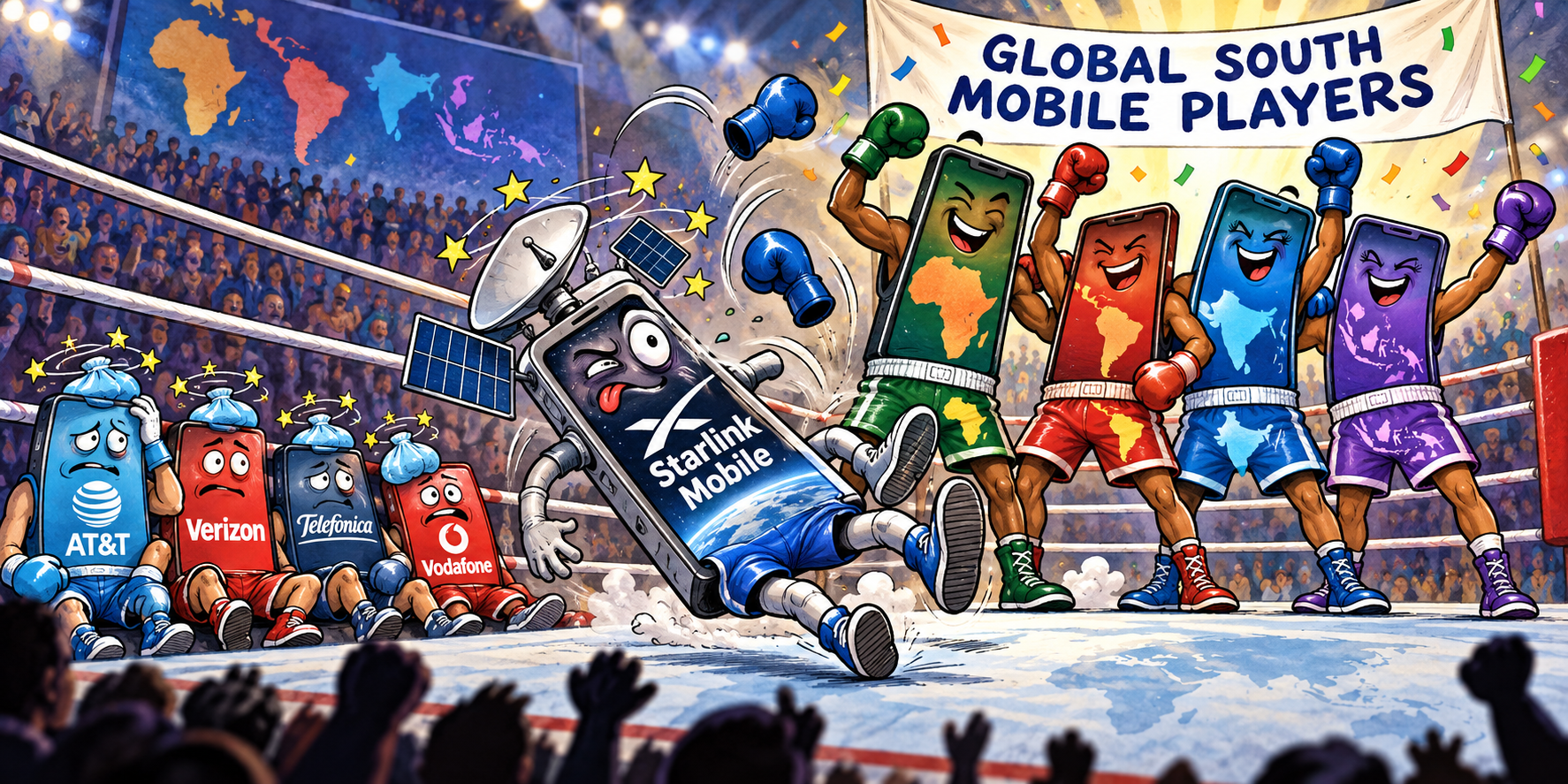
All this activity has fueled speculation about Starlink’s imminent and successful arrival in other markets. The reasoning rests on a fallible premise: if Starlink can take on Verizon and AT&T in the United States, or make Vodafone and Telefónica tremble in Europe, its arrival in the markets of the Global South will be a tsunami that operators such as Telcel, Vivo, MTN, Safaricom, Telkomsel or Jio will be unable to hold back. All the more so, the argument goes, because these markets have less terrestrial coverage, giving satellite connections a greater advantage. This assumption usually comes with the claim: “If there’s one thing Starlink has, it’s money to spend.”
But having money to spend is not the same as being willing to spend it without a reasonable prospect of return. Seen that way, a fully standalone Starlink Mobile is highly unlikely in the short or medium term in its main Global South markets, such as Argentina, Brazil, the Philippines, India, Indonesia, Kenya, Mexico, Nigeria, Zambia and Zimbabwe.
The reason is very simple: it would be extraordinarily expensive, and the operator would be very unlikely to recoup the investment in the short or medium term. Moreover, such a move would jeopardize the partnerships that offer Starlink the most profitable route into these markets. Starlink could compete effectively in these markets not as a new entrant, but by acquiring and strengthening an already established operator.
Looking at the Finances
One pillar of entry into the US mobile market is the high average revenue per user (ARPU) its operators report. AT&T reported postpaid phone ARPU of $58.01 in the second quarter of 2026, and T-Mobile reported $50.37 for 2025. That is why spending tens of billions on spectrum there can make sense: spread $27.6 billion over ten years across 30 million subscribers, and the purchase costs about $7.67 per subscriber per month. It is a considerable cost, but a market where customers pay more than $50 can absorb it.
The ten Global South markets mentioned above are far from those figures. In early 2026, Telcel’s mobile ARPU was 187 Mexican pesos (about $10.70), the highest in the group. Claro Brasil reported 27 Brazilian reais, roughly $5, while Vivo’s postpaid customers pay about $10. Claro Argentina’s ARPU of 7,848 Argentine pesos was equivalent to about $5.50 at the first-quarter exchange rate. Telkomsel’s first-half ARPU of 45,600 Indonesian rupiah is under $3. Airtel India’s 264 rupees and Jio’s 215.6 come to about $3 and $2.50, respectively. MTN Nigeria’s ARPU rose by two-thirds in 2025 after a regulator-approved tariff increase but still reached only $3.60. In the Philippines, Globe priced its Starlink satellite add-on at 99 Philippine pesos, about $1.70, a reasonable benchmark for what most users will pay for satellite coverage. In Kenya, Zambia, and Zimbabwe, where prepaid dominates, prices are single-digit.
Let us apply the same calculation to these markets. Suppose Starlink spent just one-tenth of its US outlay, $2.76 billion, on spectrum in a large market and spread that cost over ten years and 10 million subscribers. That comes to $2.30 per subscriber per month, between 75 and 90 percent of what a customer in Indonesia, India, or Nigeria pays. And that is before paying for a single satellite, ground site, tax, commission, or call-center salary.
Starlink’s position also contains a contradiction. Satellites are most valuable for off-grid rural households, fishing communities and remote farms. Those are the customers with the lowest ARPU in every one of these countries. The customers who pay the most, urban postpaid users, live where satellite capacity per beam is scarcest, where terrestrial cells are cheapest per gigabyte, and where fiber-to-the-home connections keep growing. Starlink would be strongest where customers pay the least and weakest where they pay the most.
Currency risk compounds the problem. Starlink’s costs are denominated in dollars: satellites, launches, debt, and much of the ground equipment. Its revenues would be in pesos, reais, naira, rupees, and kwacha. The Argentine peso lost 23 percent against the dollar through June 2026, with inflation at 33.5 percent. The naira went from 471 to more than 1,300 to the dollar between mid-2023 and the 2025 tariff review. Local operators manage this exposure with local revenues, local suppliers, and decades of experience. A new entrant financing its rollout in dollars would take the full hit.
Spectrum: Earth Versus Space
Owning spectrum in the United States gives Starlink no rights in Jakarta or Lagos. EchoStar’s 2 GHz rights are national licenses, not a global passport. Today, every direct-to-phone service Starlink provides in the Global South uses its partner operator’s spectrum, not its own.
In Brazil, ANATEL extended the authorization for Vivo’s direct-to-device service until April 2029. The service uses Vivo’s 2.6 GHz frequencies on a secondary, non-interference-protected basis within a regulatory sandbox, and only for low-traffic services such as messaging and emergency communications. Vivo is the authorized entity; Starlink is its supplier and cannot sell the service directly to consumers. MTN Zambia’s trials also used MTN’s spectrum, and a commercial launch depends on approval from Zambia’s Information and Communications Technology Authority (ZICTA), the regulator. Globe launched it in the Philippines as an add-on to its own plans.
To operate independently, Starlink would need spectrum under its control, and both routes are difficult. The first is mobile satellite service spectrum. At the International Telecommunication Union (ITU), agenda item 1.13 of the 2027 World Radiocommunication Conference (WRC-27) is still under study to determine whether that service will be allowed in the 694 MHz to 2.7 GHz bands used by ordinary phones. “No change” is one of the options. The others include strict conditions: satellites may not cause harmful interference to terrestrial mobile networks, may not claim protection from them, and require national authorization in each country.
Operators are not waiting for WRC-27; Europe has already shown how the battle is fought on the political front: the European Commission’s proposal for the 2 GHz band limits operators from outside the European Union to one-third of the band, and the continent’s four largest operators are considering a joint bid to keep it out of Starlink’s reach. In the United States, AT&T, T-Mobile and Verizon have formed a D2D satellite services joint venture for the same purpose.
The second route is buying terrestrial spectrum for the ground layer of a hybrid network, which means facing some of the developing world’s highest pricing regimes. Mexico’s annual spectrum-use fees have long been among the highest in the region. The government’s 2027 economic package proposes a 12 percent cut, but only for bands priced above the international median, and it excludes the 600 and 700 MHz bands, the low bands a new coverage-focused operator would need. The clearest warning about the economics of the Mexican market is Telefónica, one of the world’s largest operators: it abandoned its own radio network there and runs on AT&T’s, pending its exit from Mexico once the regulator approves its sale to Oxio.
In India, the Telecommunications Act of 2023 assigns satellite spectrum administratively but requires terrestrial access spectrum to be auctioned. A hybrid Starlink network would have to bid against Jio and Airtel. Satellite spectrum has also been contentious there. In September 2026, the Digital Communications Commission approved the Telecom Regulatory Authority of India (TRAI) recommendations on satellite communications: a 4 percent charge on adjusted gross revenue. The Department of Telecommunications had argued for 5 percent, and TRAI also proposed an additional 500 rupees per urban subscriber per year.
Starlink had argued for a charge below 1% and is still awaiting spectrum assignment and a second-phase security clearance. In Indonesia, the Indonesian Cellular Telecommunications Association (ATSI) puts total regulatory charges at 13 to 14 percent of revenue and warns they could exceed 28 percent under a new spectrum regime, while Komdigi, the communications ministry, is still consulting on satellite-to-phone service in the 2 GHz band.
Finally, Brazil’s 2021 5G auction focused mainly on coverage and investment obligations rather than cash payments, so a new licensee would take on obligations aimed precisely at rural areas that generate little revenue.
The Laws of Physics
Even with spectrum available, the technology itself imposes limits that bite hardest where monthly bills are lowest. The hard question about Starlink’s service for ordinary phones is not whether it works. It is whether it can work reliably at a cost covered by a $3 monthly bill. The figures that follow are engineering illustrations, not measurements of Starlink’s performance or costs, but they show the scale of the problem.
Let us start with shared capacity. Take 10 MHz of usable bandwidth at a spectral efficiency of 1 to 3 bits per second per hertz. That yields 10 to 30 Mbps per reusable radio resource, before overhead. At 1 Mbps per active user, that is enough for only 10 to 30 people at the same time. A satellite can operate multiple beams and reuse its spectrum among them. Even so, covering a large area isn’t the same as having capacity for everyone who lives there, and a beam over a densely populated neighborhood in Manila, Lagos, or São Paulo serves an enormous number of potential users.
Spectrum narrows that margin further. All else being equal, 5 MHz offers half the raw capacity of 10 MHz. The partner-based Direct to Cell model runs on operators’ LTE spectrum between 1.6 and 2.7 GHz, often in small bandwidth blocks: in Brazil, Vivo’s sandbox uses 5 MHz channels. Interference rules and coordination with neighboring countries limit how intensively that spectrum can be reused.
The phone-to-satellite link is the next problem. A typical LTE phone transmits at most about 0.2 watts (23 dBm). Compared with a phone talking to a tower 5 km away, a satellite 500 km overhead has 40 dB more free-space path loss at the same frequency, meaning 10,000 times less received power, before accounting for antenna gains and other differences. Huge satellite antennas and very sensitive receivers make up that difference. But the business case is to serve users on the cheap phones they already own, so the device side can’t be improved.
Walls make things worse. Every additional 10 dB of obstruction cuts received power tenfold, and 20 dB cuts it a hundredfold. Losses vary by material, but the concrete and rebar of Latin American and Asian cities give no quarter. Starlink itself says its service for existing phones works where users can see the sky. A connection that works in a field can fail in a home, a shop or a market stall. Closing that gap requires ground infrastructure, and the monthly bill has to pay for it.
Motion adds another difficulty. A satellite in low Earth orbit travels at about 7.5 km/s. At 2 GHz, that produces a theoretical maximum Doppler shift of about 50 kHz. The network compensates for it, but Doppler shifting, signal delays, and frequent handovers between satellites and beams are well-known challenges in mobile satellite systems. Every dropped session or retransmission wastes scarce capacity, raises support costs, and reduces what customers are willing to pay.
Devices are also a cost. A phone that supports only 2G/3G cannot use LTE, and even a 4G phone must support the right band and configuration. Compatibility has to be checked against the devices people actually use in each market. If upgrading a phone required a hypothetical $30 subsidy, that would equal ten months of gross revenue at a $3 ARPU, before any network cost.
When these limits are translated into money, the margins are thin. At a $3 ARPU, one million subscribers generate $3 million a month, or $36 million a year, before any expenses. Adding $1 per subscriber per month in network costs for more satellites, more beams, or more ground sites consumes a third of that revenue. A modest $0.50 per subscriber per month for core network integration, routing, billing, authentication, and support consumes another 17 percent. Data usage makes this even clearer. A customer who pays $3 and uses 1 GB a month generates $3 per gigabyte. At 10 GB, that falls to 30 cents; at 30 GB, to 10 cents. That has to cover all costs, not just transport. Monthly totals also hide the peak-hour problem: capacity must be sized for the afternoon and evening hours, when everyone connects at once, not for the monthly average.
The toughest obstacles, then, are capacity per dollar, indoor coverage, and the phone’s weak uplink. Solving all three becomes more expensive precisely as revenue per user declines.
The Need for Towers
Physics explains why SpaceX’s own US plan includes terrestrial base stations and why any serious mobile service in these markets would need them even more. Building that terrestrial layer in the Global South is a challenge in itself. Telkomsel operates some 301,000 base stations. In Zambia, Airtel’s recent $107 million program added 406 sites, at roughly $260,000 per site all-in by my rough estimate, and it materialized only after the regulator raised concerns about service quality. A new hybrid operator serving only the dense cores of São Paulo, Mexico City, Lagos, Jakarta, Mumbai, and Manila would need thousands of sites. Most towers belong to companies tied to the incumbents: Indus in India, IHS in Nigeria and Zambia, Telesites in Mexico and Mitratel in Indonesia.
On top of that, incumbents have spent decades learning to manage the operating conditions. Nigerian sites run on diesel and suffer fiber cuts from damage and vandalism. Zambia and Zimbabwe have endured long periods of scheduled power outages. Brazil battles persistent cable theft. In parts of Mexico, organized crime threatens field crews. Incumbents also keep reinvesting at a pace a newcomer would have to match. MTN Nigeria put 620.5 billion naira into capital expenditure in the first half of 2026. Globe spent 26.3 billion Philippine pesos, equivalent to 31 percent of its service revenue. Vivo invested 2.59 billion reais in a single quarter, and Telecom Argentina about $639 million in six months. A satellite network is a powerful complement to all of this, but not a substitute.
The Users
In the United States, Starlink argues it can sell mobile service to its existing broadband customers while keeping acquisition costs low. That base is too small in most of these markets. Brazil could be considered the exception, with more than one million Starlink broadband subscribers in a territory almost the size of the United States. Elsewhere, Nigeria had 98,642 in mid-2026, Zimbabwe about 86,000, and Kenya 27,616. MTN Nigeria has 92.2 million mobile customers; the Safaricom group, 71.6 million; Telkomsel, 153.5 million; Globe, 67.7 million; and Vivo, 105.1 million accesses. The base to which Starlink could upsell would be negligible by comparison.
Beyond that base, Starlink would have to win customers in some of the world’s toughest retail environments. Prepaid SIM cards and top-ups are sold through hundreds of thousands of small agents, kiosks and distributors who earn commissions. Before activation, customers must pass identity checks: Aadhaar-based e-KYC verification in India, Nigeria’s requirement to link every SIM to a national identity number, the Philippines’ 2022 SIM Registration Act, and Mexico’s new rule linking mobile lines to the CURP.
Many phones are bought on credit through arrangements with operators and their partners, as Safaricom does with M-Kopa. Devices are also a constraint: smartphone penetration at MTN Nigeria is 66.4 percent, so a third of its base cannot use a data-centric satellite service at all, and even Globe’s launch initially excluded iPhones. Most users have more than one SIM, so a Starlink line would probably become a cheap emergency backup, with low revenue and high churn. Starlink would also need number portability and interconnection agreements with the very incumbents it would try to displace, on terms set by regulators already acting cautiously.
Taxes
The burden of taxes and fees adds another difficulty that a new entrant would face from day one, with a small subscriber base. A Deloitte study commissioned by the GSMA estimated that roughly 37 percent of a Brazilian mobile bill goes to taxes, mainly the state ICMS (similar to value-added tax), along with the Fund for the Inspection of Telecommunications (FISTEL), Universalization Fund for Telecommunications Services (FUST), and Fund for the Technological Development of Telecommunications (FUNTTEL) sector funds. Vivo alone paid about 13 billion reais in taxes in 2025, roughly 22 percent of its revenue, and is contesting 7.3 billion reais in FISTEL fees. Brazil’s tax reform, with the new Tax on Goods and Services (IBS) and Contribution on Goods and Services (CBS) taxes, begins phasing in from 2027 and creates uncertainty during the transition.
Mexico combines VAT and a special tax on telecommunications services with its high spectrum fees. Argentina adds VAT, provincial gross-receipts taxes and a universal service contribution, against a backdrop of currency depreciation. India adds an 18 percent Goods and Services Tax (GST) and an 8 percent license fee on adjusted gross revenue, before any satellite spectrum charge. Indonesia’s regulatory charges already amount to 13 to 14 percent of revenue.
Kenya taxes airtime and data on top of VAT, has a new satellite gateway station license costing at least 15 million shillings plus up to 0.4 percent of turnover, and is debating a 25 percent excise duty on every activated phone, although its Finance Committee has recommended scrapping it. Zimbabwe taxes electronic money transfers. Nigeria requires regulatory approval of retail tariffs and forced Starlink to price in naira; the company’s 2024–2025 price increases led to regulatory disputes. Incumbents spread these costs across tens of millions of lines; a newcomer cannot.
Different Obstacles
Each country has its own decisive constraint. Brazil is Starlink’s largest market in the Global South, but its route into mobile runs through Vivo, in a regulatory sandbox. When ANATEL authorized 7,500 additional satellites in 2025, it attached a formal warning about risks to competition, orbital sustainability, and digital sovereignty, and the memory of the 2024 clash with Brazilian Supreme Federal Court Justice Alexandre de Moraes, who froze Starlink’s accounts, has not faded.
Although Mexico has the group’s best ARPU, it also has high spectrum fees, a dominant Telcel, and a new regulator, the Telecommunications Regulatory Commission (CRT), under the 2025 telecommunications law. According to press reports, talks with América Móvil ended in 2025 after Musk criticized Carlos Slim, so Starlink has no direct-to-phone partner there.
Milei’s Argentina offers the most favorable political environment: deregulation sped up Starlink’s authorization. But low dollar ARPU, high inflation, and exchange-rate swings make any multi-year payback hard to model, and commercial direct-to-phone service still depends on a deal with Claro, Movistar, or Personal.
Indonesia, with more than 17,000 islands, is the most compelling case for satellite coverage. However, regulatory charges are high. The framework for satellite-to-phone service is still under consultation. Starlink already had to meet local-operation requirements to enter, and Telkomsel, majority state-owned, is both a political and commercial counterpart.
India is the biggest prize and the hardest market. It combines security clearances, auctioned access spectrum, a contested satellite communications charge, and two dominant operators that currently distribute Starlink broadband. They would undoubtedly become adversaries the moment Starlink sold mobile service.
In the Philippines, Globe already serves as the distribution channel. Globe’s share of earnings from Mynt, the company behind GCash, accounted for 28 percent of its pre-tax income in the first half of 2026, which shows that subscriber revenue is not these operators’ only major source of income. The Konektadong Pinoy Act of 2025 eased entry for data transmission providers, but only after incumbents strongly opposed it.
Nigeria‘s ARPU recovered after the 2025 tariff increase, but the market is overwhelmingly prepaid and tied to national identity. The Nigerian Communications Commission is still consulting on whether existing terrestrial licenses can cover satellite-to-phone services or whether a new category is needed.
In Kenya, M-Pesa accounts for 45.6 percent of Safaricom’s domestic service revenue, so a connectivity-only entrant competes for less than half of the available profits, and the Communications Authority is already reviewing interference between Airtel’s and Starlink’s services.
Zambia is a small, poor, and already contested market: MTN and Starlink completed Africa’s first direct-to-phone trials, and the regulator pushed Airtel into a $107 million rollout.
In Zimbabwe, Starlink entered cheaply, with about $575,000 in licenses compared with the $137 million attributed to Econet. But POTRAZ controls the dealer channel, a mobile license falls under a different category, and very low ARPU, currency risk, and Econet’s EcoCash ecosystem limit what a new mobile operator could earn.
Home Turf
The most underestimated part of this debate is everything Global South operators do beyond carrying calls and data. Mobile money is the most important business. M-Pesa, GCash, MTN MoMo, Airtel Money, EcoCash, Claro Pay, Vivo Pay, and Personal Pay turn operators into financial institutions for millions of people without bank access. Their agent networks also serve as identity-verification points and cash-in and cash-out counters. Starlink’s own launches prove it: Globe’s satellite service promotes GCash, and MTN Zambia’s promotes MoMo. The satellite is a new channel for the operator’s financial products, not a substitute.
Operators also run the distribution and identity systems that determine who can legally hold a phone number. They finance devices and repair them. They take on universal service obligations: connecting schools and health centers, broadcasting public alerts, routing emergency calls, and providing lawful interception of communications. When disasters strike, they lead the response. After the magnitude 7.8 earthquake in Sarangani in June 2026, Globe activated Starlink text messaging for the affected areas.
Operators build private networks for mining, oil, and agribusiness; manage fleets of Internet of Things (IoT) devices; and develop sector partnerships, such as TIM’s initiative to cover rural agribusiness areas in Brazil. They maintain content and zero-rating deals that reduce churn among prepaid customers. In space, they have alternatives: AST SpaceMobile, Lynk, and Skylo are pursuing similar partnerships. If Starlink competes with its own partners, they can switch suppliers, as Telefónica and Orange are already doing in Europe through Satellite Connect Europe, the joint venture between Vodafone and AST SpaceMobile.
Partner, Not Predator
None of this means Starlink has no future in the Global South’s mobile markets. It has a very promising one, but as a supplier, not as a rival operator. Economics and physics point in the same direction. A satellite beam excels at covering empty spaces but struggles to serve crowds. A weak phone signal works under open sky and struggles indoors. At $3 a month and 10 gigabytes, each gigabyte must carry about 30 cents of the cost. The right design for low-ARPU countries is hybrid: terrestrial networks carry everyday traffic in busy cities and towns, and satellites extend coverage to underserved areas where towers will never be economically viable. Local operators already own the ground half. Starlink complements them.
That division of labor is already a large, high-margin business. Starlink can provide coverage where none exists, emergency messaging and service continuity during disasters, backhaul for remote cell sites, and enterprise and IoT connections for mines, farms, fleets and assets at sea. The Airtel Africa agreement spans 14 markets and some 174 million customers who could eventually use it. Globe, Vivo, MTN Zambia and Entel in Chile and Peru are already operating or about to. None of it requires Starlink to buy spectrum country by country, build towers in Lagos, recruit kiosk agents in Surabaya, verify identities in Lucknow, or serve from orbit the evening traffic of millions of customers paying $3.
Selling direct would flip that logic. It would mean making the investments of a major operator in spectrum, terrestrial networks, distribution, identity systems, taxes, and currency exposure. It would also mean investing heavily in satellite capacity to carry urban, indoor, and peak-hour traffic that terrestrial cells carry at far lower cost. All of that would have to be recouped from monthly revenues of $2.50 to $11 per user, while today’s partners become tomorrow’s adversaries and turn to AST SpaceMobile, Lynk, or Skylo.
The United States, with ARPU above $50, may sustain a fourth operator built on satellites and terrestrial cells. In Brazil, Mexico, Argentina, Indonesia, India, the Philippines, Nigeria, Kenya, Zambia and Zimbabwe, the smartest and, almost certainly, most profitable strategy is to remain operators’ indispensable partner, carrying traffic for them from the hardest-to-reach areas.
Of course, there is a remote possibility that Starlink ultimately enters each of these Global South markets by acquiring an established, well-known, and profitable operator. In that case, the whole equation would have to be revisited.
José Otero has spent 30 years advising regulators and operators in 50+ countries across the Americas, Europe, and Asia on the governance of emerging digital technology. He writes here on the widening gap between what digital technologies can do and the rules, institutions, and infrastructure meant to govern them.
Connect on LinkedIn or reach out at jfo@ictdconsult.com.

